

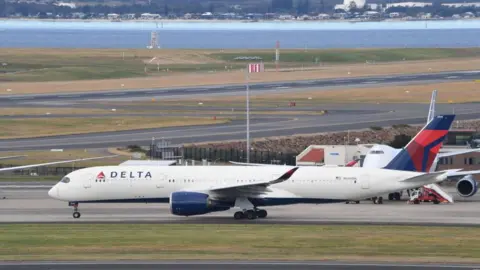
Multiple passengers and crew have been injured after a Delta Airlines flight traveling from LA to Sydney, Australia encountered significant turbulence Friday morning.
The flight, numbered 41 "went through a short bout of rough air" as it touched down at Sydney Airport, an airline spokesperson informed. A number of the onboard staff sustained injuries.
The New South Wales Ambulance Service said they assessed a total of five people, and transferred three to a medical facility with non-life-threatening injuries that comprised back pain and head pain. The patients' ages ranged from their 30s up to the 70s.
This marks the latest incident of planes experiencing severe turbulence, with researchers pointing out that shifting climate patterns is a significant contributor.
On board were nearly 250 travelers and a crew of 15 on the Airbus A350, the official said, stating that the plane landed "safely and normally" at the airport at shortly before 7 a.m. on the day in question.
The NSW Ambulance Service indicated they were alerted just a mere three minutes before the plane arrived, and ambulances were ready and waiting at the airport.
Why in-flight bumpiness is getting more frequent - and often stronger.
In the previous year, twenty-five passengers and crew were hurt when a Delta Airlines flight, on a route from Salt Lake City to Amsterdam, encountered "severe" turbulence just a couple of hours into the lengthy trip, and diverted for an precautionary landing.
Recently, travelers and staff on a Singapore Airlines flight endured a frightening five seconds bout of severe turbulence. A traveler passed away and numerous people sustained injuries, as unbelted passengers rose out of their seats and fell back down.
In-flight turbulence is fairly routine during flights, and while cases of strong or severe turbulence are reportedly becoming more frequent, they are remained quite uncommon.
Research indicates that there are an estimated thousands of instances of severe-or-greater turbulence every year, out of a overall number of more than 35 million aircraft departures that now take off worldwide.
Severe turbulence is defined as when the sudden jolts of a aircraft passing through disturbed air apply greater than 1.5g-force on your body - enough to propel you from your seat if you did not have on a safety belt.
As climate change modifies the conditions in the sky, researchers alert that flying could become more turbulent: warming trends and shifting wind patterns in the upper atmosphere are expected to increase the occurrence and strength of dangerous in-flight bumps.


